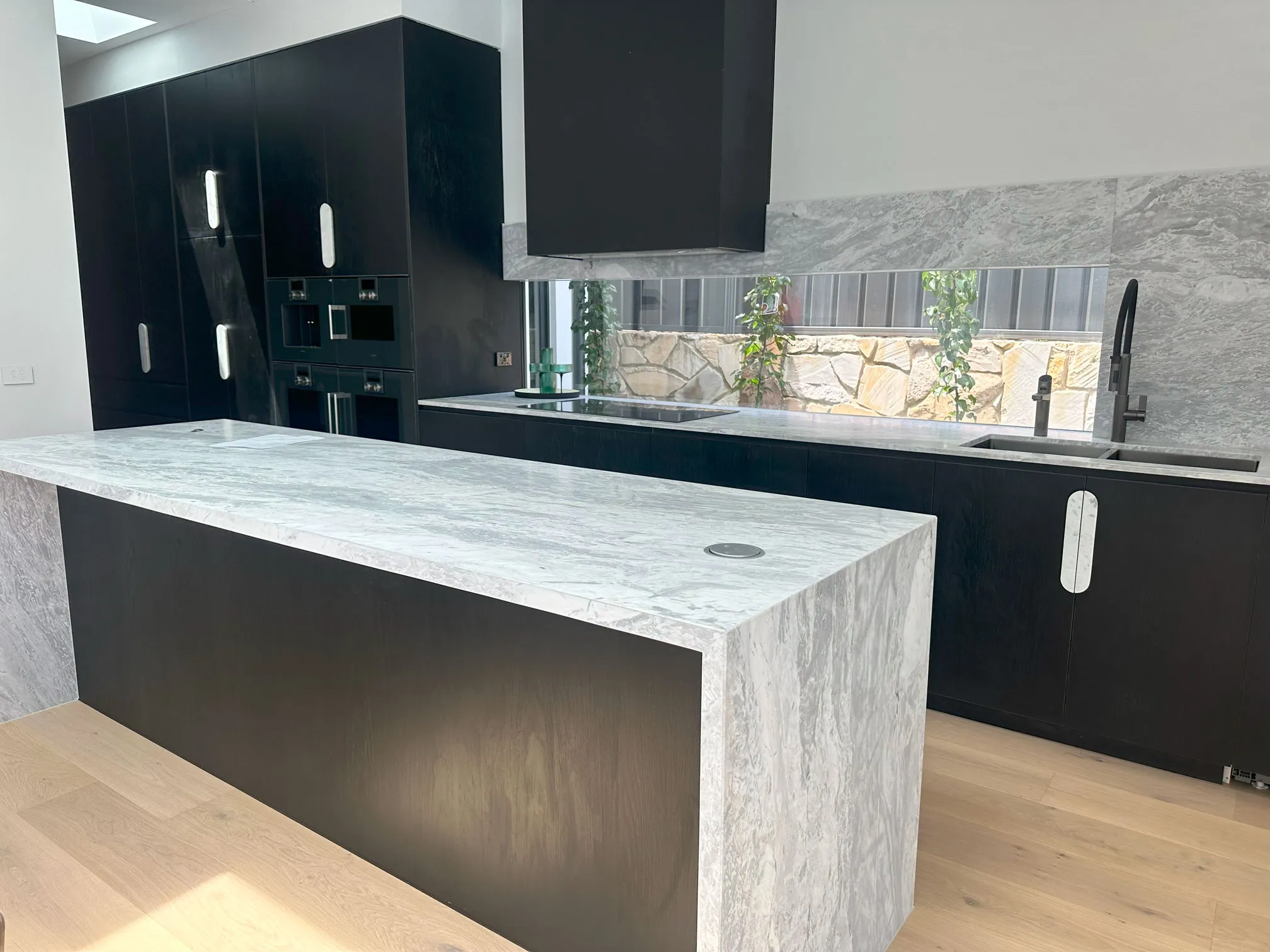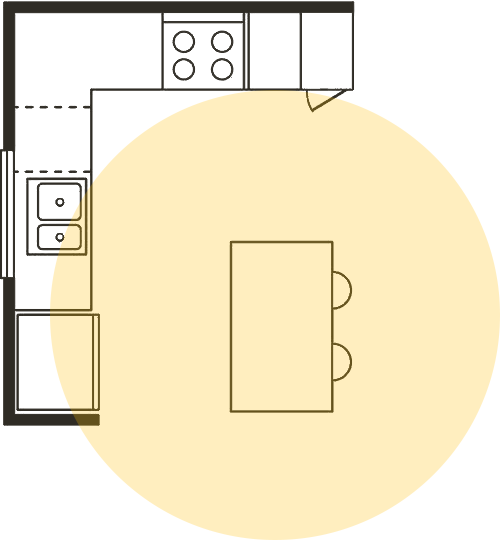
A kitchen island can completely change how a kitchen functions, but it is not the right fit for every layout. When planning kitchens in Canberra, the island needs to suit the room’s proportions, circulation space and everyday use, not just the overall design style. A successful design depends on more than visual appeal. It requires careful consideration of floor area, appliance clearances, storage needs and how the room is actually used.
Caliber Kitchens explores the key measurements, layout factors and functional priorities that determine whether an island will enhance the space or create limitations. The goal is to make sure any design decision is grounded in real usability rather than trends.
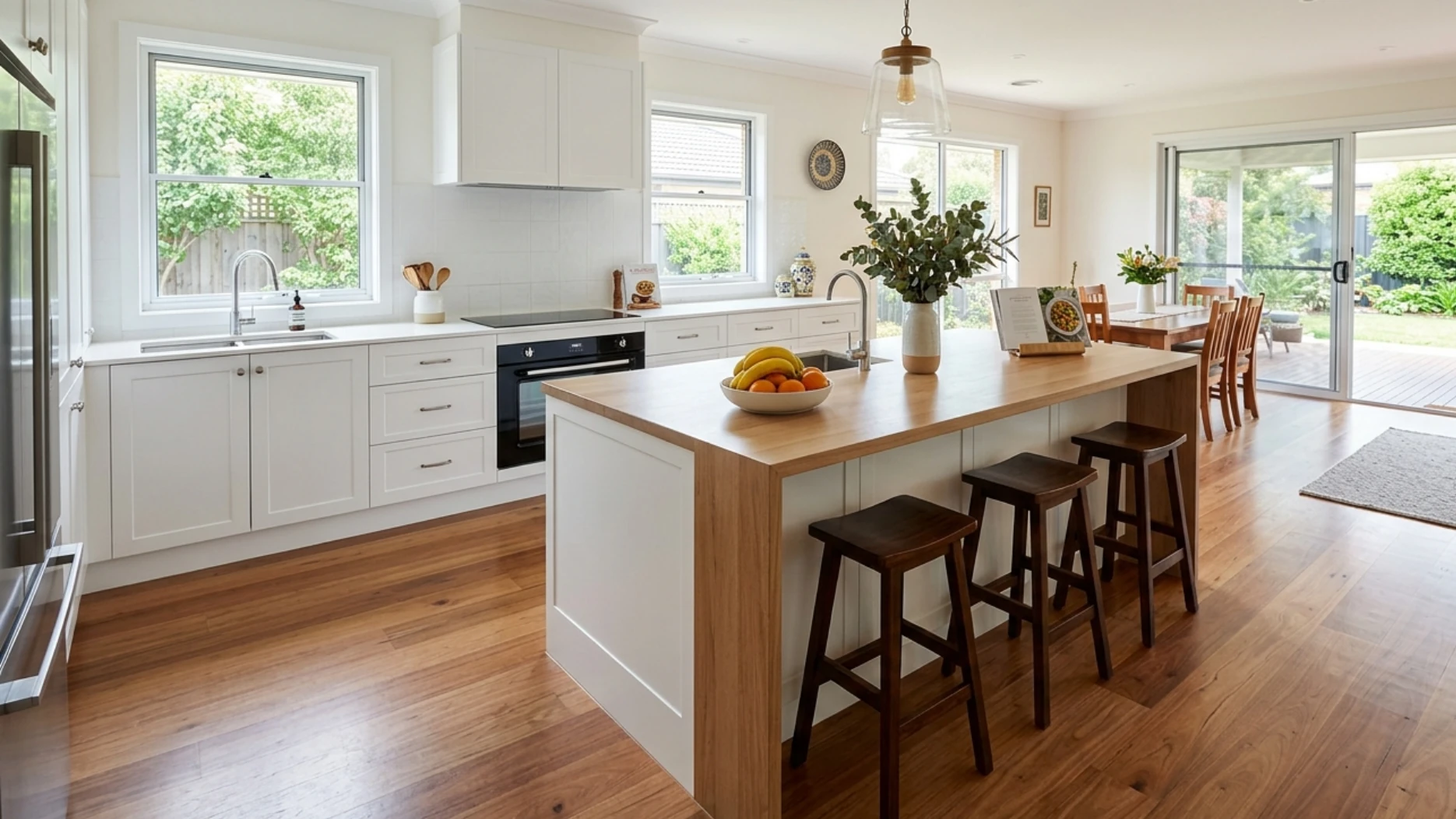
What Makes a Kitchen Suitable for an Island
Not every kitchen can comfortably accommodate an island, even if the room is technically wide enough. A suitable space allows people to move freely around the island, open appliances without obstruction and use work surfaces safely and efficiently. The most successful islands feel integrated into the kitchen’s workflow rather than squeezed in as an afterthought.
Before committing to an island, it is important to look beyond the footprint of the cabinet itself. Clearances, circulation paths, appliance positions and sightlines all need to be considered. A kitchen that meets these practical criteria is far more likely to benefit from an island functionally and visually.
Adequate Overall Room Size and Clearances
The starting point is the size and shape of the room. As a rule of thumb, most kitchens need at least 3.5 to 4 metres of width from one run of cabinetry to the opposite wall for a central island to work comfortably. Very narrow galley kitchens rarely suit an island and may be better served by a peninsula or slimmer benchtop solution.
Clearance around the island is critical. A working kitchen should allow approximately 1 metre of walkway between the island and any surrounding cabinets or walls. This distance makes it easier for people to pass each other, open appliance doors and move safely while cooking. In a compact space, around 900 mm may be workable as an absolute minimum, but anything tighter quickly feels restricted in daily use.
It is not enough to measure the room as an empty space. Measurements must account for installed base units, handles and the swing of oven, dishwasher and fridge doors. A kitchen is suitable for an island only if those clearances remain practical once everything is installed.
Logical Workflow and Appliance Placement
A well-planned island should improve the kitchen workflow rather than disrupt it. The classic relationship between the sink, cooktop and fridge still matters, even in modern open-plan kitchens. The island can support this layout by acting as a central prep zone, storage point or working surface between key areas.
Suitable kitchens have appliance locations that do not conflict with island seating or main walkways. For example, a dishwasher directly opposite bar stools can cause regular clashes. A cooktop on the island needs safe clearance behind seating areas and enough space for a suitable rangehood or extraction system, whether ceiling-mounted, integrated or otherwise planned into the design.
Power and services are also important. If the island will house an appliance, sink or power points, the room must allow for plumbing and electrical routes through the floor, walls or ceiling. In an existing Canberra home, this feasibility check is a key part of deciding whether the kitchen can genuinely support an island without creating unnecessary cost or disruption.
Circulation Routes, Light and Sightlines
A kitchen is well-suited to an island when it can accommodate natural circulation routes. Entry doors, patio doors and paths to the dining or living area should not be blocked or narrowed by the new element. The island should guide movement through the space, not create a maze.
Lighting and sightlines also influence suitability. An island works best where task lighting or pendants can be added without clashing with beams, bulkheads or low ceilings. The room should still feel open from key viewpoints, such as the entrance or adjoining living area. If an island would visually cut the room in half or make it feel enclosed, the layout may be better served by a slimmer unit, peninsula or alternative design.
How Much Space Do You Need Around an Island?
The clear space around a kitchen island determines how comfortably the room functions day to day. It affects how easily doors open, how safely people move with hot pans and whether more than one person can cook or pass through at the same time. Before choosing an island style, it is best to measure the circulation space first, then determine what size island is possible inside that footprint.
Most kitchens need a minimum of 900 mm of clearance on working sides of an island, with 1000 to 1200 mm often feeling more comfortable. The right dimension depends on who uses the kitchen, how often the space is shared and which appliances sit opposite the island.
Minimum Clearances for Everyday Use
For a compact kitchen where one person cooks at a time, 900 mm between the island and the surrounding cabinets is usually the minimum practical clearance. This allows cabinets to open and gives someone enough room to stand and work, although it may still feel tight if another person needs to pass behind.
Extra space is recommended if the island sits opposite:
- Oven or dishwasher doors that drop down
- A fridge door that needs to swing wide
- Pull-out bins or pantry units
In these cases, increasing the clearance to around 1000 to 1100 mm makes the kitchen easier and safer to use. It allows appliance doors to open without blocking the entire walkway and reduces the risk of people bumping into hot, sharp or heavy items.
Ideal Space for Busy or Family Kitchens
In larger or busier kitchens, 1100 to 1200 mm of clearance around the main working sides of the island feels noticeably more comfortable. This width suits households where two people often cook at once, children move through the kitchen during meal prep or guests gather around the island while food is being prepared.
If the island includes seating, allow around 600 mm per stool so people are not crowded. Behind the stools, there should be at least 900 mm of clear walkway so someone can pull a stool out and another person can still pass. In an open-plan layout where the island backs onto a key route, such as the path to the dining table or outdoor entertaining area, 1100 to 1200 mm behind the stools is preferable.
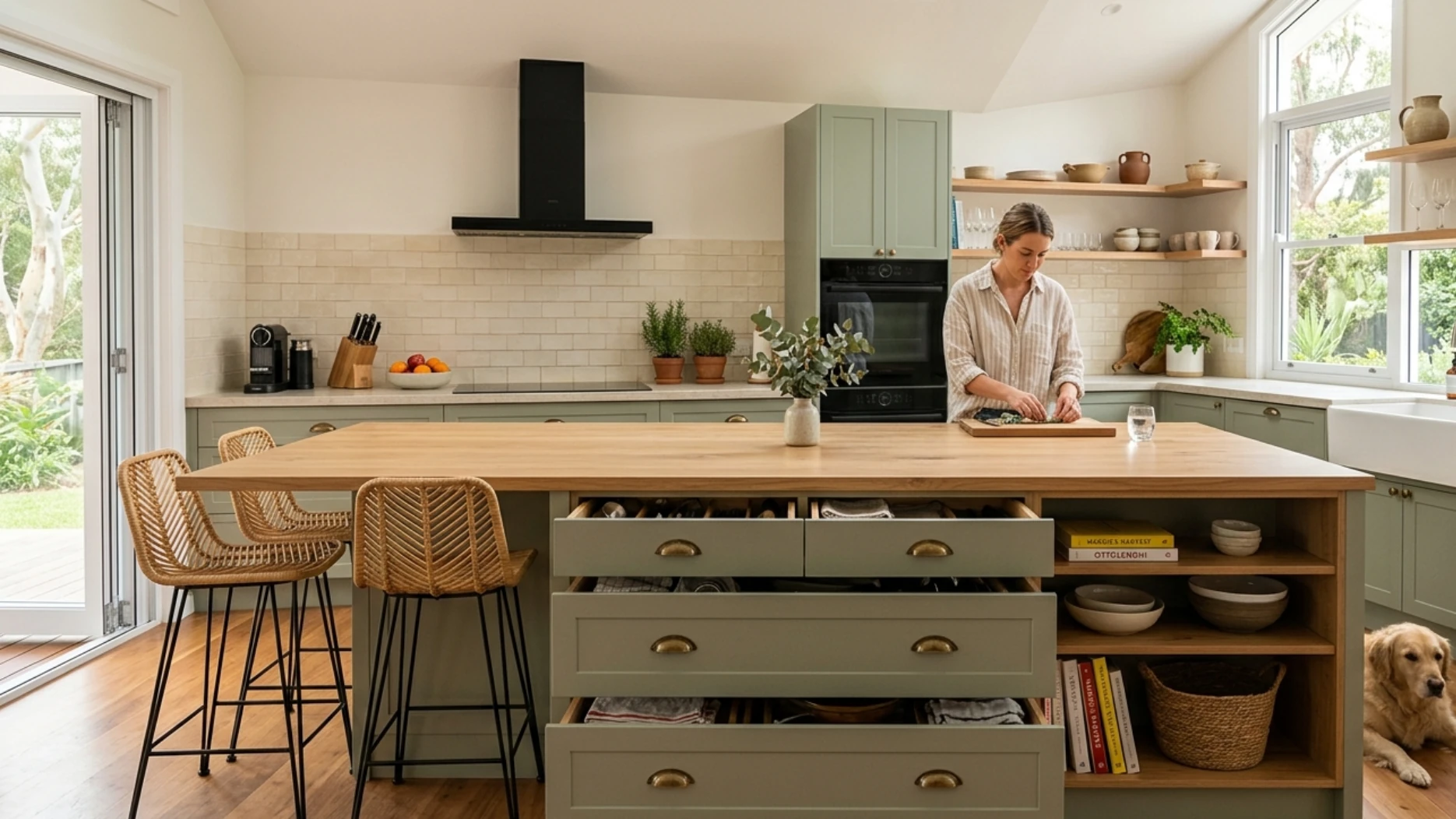
How the Island Can Affect Movement, Storage and Daily Use
A kitchen island changes how people move, cook and gather in the space, so its impact reaches far beyond how it looks. Before committing to one, it is important to understand how it will affect walking routes, appliance access and everyday tasks from breakfast through to entertaining.
A well-planned island can streamline food prep and add valuable storage. A poorly placed or oversized island can block doors and drawers, create congestion and make daily routines frustrating. The key is to test how the island will function in real use, not just how it fits on a floor plan.
Movement and Traffic Flow
Movement is the first test of whether an island truly fits. The island should allow people to move naturally between the sink, fridge, cooktop and dining area without constantly stepping around obstacles. In long or narrow kitchens, an island can easily become a barrier, so a slimmer island or peninsula may suit circulation better.
Check clearances with doors and appliances fully open. The oven, dishwasher and fridge must be able to open without hitting the island or trapping someone in a corner. If the island is opposite a dishwasher, there should be enough space for someone to stand at the open dishwasher while another person can still pass behind.
Traffic flow is especially important in open-plan homes, where the kitchen often connects to dining, living or outdoor spaces. The island should support these routes rather than interrupt them.
Storage and Appliance Planning
An island often becomes prime storage, so its layout needs as much thought as its size. Deep drawers in the island are ideal for pots, pans and mixing bowls used near the cooktop, while shallow top drawers suit utensils and everyday cutlery if seating is nearby.
Assign zones deliberately. If the island sits opposite the cooktop, store pans and cooking tools on the side that faces the cooking area. If it backs onto a dining area, dedicate one section to plates, napkins and serving dishes so the table can be set without crossing the main cooking zone.
Appliance placement on the island affects both storage and movement. A sink in the island boosts prep space but reduces under-bench storage and adds plumbing complexity. A cooktop in the island changes how extraction works and requires more safety clearance at the edges, especially near seating. Compact appliances, such as a wine fridge or microwave drawer, can work well at the end of an island facing a living or dining area so they can be accessed without interrupting the main cooking zone.
Everyday Use and Comfort
Think through daily routines. If breakfast happens at the island, there needs to be enough legroom under the benchtop and enough space for stools to slide back without blocking walkways. Allowing roughly 600 mm of width per stool helps prevent people from feeling crowded.
Work surfaces should match how the kitchen is used. A generous, uninterrupted stretch of benchtop is often more useful than several small sections broken up by sinks or cooktops. If baking, meal prep or entertaining is frequent, keeping at least 900 mm of continuous space on one side of any island sink or cooktop can make the area far more practical.
Lighting and power also shape daily use. Good task lighting above the island reduces shadows when chopping, serving food or reading recipes. Well-placed power points on the island end can support small appliances, laptops or phone charging without trailing leads across the benchtop.
By testing these movement, storage and daily use scenarios on paper or with tape on the floor, it becomes clearer whether an island will enhance the kitchen or get in the way of how the space really works.
What to Consider if the Island Will Include Seating, Appliances or a Sink
An island that includes seating, appliances or a sink must work harder than a plain prep surface. It has to feel comfortable to use, allow people to move around safely and suit the plumbing, electrical and ventilation requirements of the home. All of these factors affect the island’s size, shape and exact placement.
Before finalising dimensions, it is important to decide how the island will function most of the time. Casual dining, everyday meal prep, serious cooking and heavy clean-up all demand different clearances, overhangs and service connections.
Planning for Island Seating
Seating instantly increases the footprint needed. Each stool typically requires 600 to 750 mm of width to avoid crowding. For depth, allow at least 300 mm of benchtop overhang for occasional seating and 380 to 400 mm for more comfortable everyday use.
Legroom also matters. A standard benchtop height of around 900 mm suits counter stools of about 650 mm seat height. If a raised bar-height section at around 1050 mm is preferred, bar stools of about 750 mm seat height are usually required. A clear path of at least 900 mm behind seated diners is recommended so others can pass without chairs needing to be pushed in every time.
Corner seating on an island can look appealing but may become cramped in practice. For stools on two adjacent sides, allow extra width at the corner or remove one seating position so knees do not collide.
Allowance for Cooktops and Other Appliances
Appliances on an island turn it into a working hub and need extra breathing space. A cooktop requires clear benchtop space on each side for safety, preparation and landing hot cookware. Around 300 mm on each side may be a starting point, but more is usually better for larger cooktops or households that cook frequently.
A suitable extraction system is essential. Options may include a ceiling-mounted rangehood, an integrated rangehood or another ventilation solution suited to the home’s ceiling height and layout. This needs to be considered early, as it can affect both the appearance and feasibility of the island.
Electrical appliances such as ovens or microwaves in the island base need adequate ventilation and suitable power supply routes. Their doors should open without blocking circulation paths. If the island will house a fridge drawer or wine cooler, consider how often it will be accessed. Placing high-traffic appliances on the outer side of the island can reduce congestion in the main cooking zone.
Including a Sink or Dishwasher
A sink in the island turns it into a clean-up or prep zone and adds plumbing requirements. Space for a full-size sink plus at least 600 mm of clear benchtop on one side as a drying or prep area is recommended. Avoid placing a sink too close to the seating edge, as splashes can reach diners and make the area less comfortable.
Plumbing and waste pipes often need to run through the floor into the island, so floor structure and access should be planned early. A dishwasher beside an island sink can be highly practical, but the open door projects into the walkway. Allowing around 1200 mm between the island and opposite units gives enough space to open the dishwasher and still move past more comfortably.
When a Peninsula or Other Alternative May Work Better
A freestanding island is not the only way to gain extra prep space and storage. In many kitchens, a peninsula or compact alternative can deliver similar benefits with better circulation, especially in tighter rooms or layouts with multiple doors and windows.
The key is to recognise when forcing an island will make the room feel cramped or awkward to use. In those cases, a peninsula or alternative can create a more efficient work zone while still giving homeowners the extra benchtop and storage space they want.
When a Peninsula Beats an Island
A peninsula is attached at one end to a wall or run of cabinetry and extends into the room. It is often the better choice when the central floor area is limited or the room is long and narrow. A peninsula works well when:
- The clear walkway around a proposed island would be less than about 900 mm
- The kitchen has a U-shaped or L-shaped layout and an island would restrict the central aisle
- There are several doorways or walkways that an island would interrupt
By anchoring one side to the wall or cabinetry, a peninsula reduces the circulation space needed because users move around three sides instead of four. It can still include seating on the outer edge, under-bench storage and even appliances such as a dishwasher or wine fridge. In some layouts, the peninsula also acts as a subtle divider between the kitchen and dining area without fully enclosing the space.
Breakfast Bars and Narrow-Depth Counters
In compact kitchens that are too tight for an island or full peninsula, a shallow breakfast bar or narrow-depth counter can be a smart compromise. This may be a slim overhang or added benchtop along a wall, window or half-height partition.
This approach suits spaces where the room width cannot accommodate deep cabinetry on both sides, but extra prep space or casual seating is still useful. Even 300 to 400 mm of extra depth can function as a laptop spot, homework zone, coffee perch or extra serving area without dominating the room.
A breakfast bar can be set at standard benchtop height for food prep or raised slightly to create casual seating on the living or dining side. The right choice depends on whether the priority is practical work surface, informal dining or visual separation between zones.
Mobile Islands and Trolleys
When fixed cabinetry would overcrowd the floor area, a mobile island or trolley can provide flexibility. These pieces are usually smaller than a built-in island and are set on locking castors so they can be repositioned or moved aside entirely.
A mobile option works well where the main need is occasional extra prep or serving space rather than permanent seating. It can be pulled into the centre when cooking for guests, then parked against a wall day to day to keep the kitchen feeling open. Choosing a unit with shelves or drawers beneath can also increase storage without committing to permanent construction.
Deciding whether a kitchen island will suit a space involves more than aesthetics. Accurate measurements, appropriate clearances, efficient workflow and realistic daily use all determine whether the layout will function comfortably. When proportion, storage needs and seating are balanced against circulation and safety, the result is a kitchen that feels natural and easy to use.
Where an island does not suit the room, alternatives such as peninsulas, breakfast bars or compact mobile units can often deliver better outcomes. Careful planning and professional input help ensure the final design supports both the space and the way the kitchen is used every day.